For any restaurant owner in Singapore, securing a top spot on Google Maps is the digital equivalent of having a prime location on a busy street. When a hungry customer searches “best ramen near me,” appearing in the top three results, the coveted “Map Pack”, can mean the difference between a quiet Tuesday and a fully booked service. But many owners wonder why their competitors rank higher. The process of how Google Maps ranks restaurants isn’t a mystery; it’s a system based on clear signals of relevance, distance, and prominence.
Understanding these signals is the first step toward improving your visibility. Google’s main objective is to provide the most helpful and trustworthy answer to a user’s query. Your job is to prove that your restaurant is that answer. If you’re struggling to appear, it’s often because your digital signals are weaker than those of your competitors.
The Three Pillars of Google Maps Rankings
Google itself states that local results are based on three main categories: relevance, distance, and prominence. Let’s break down what each one means for your F&B business.
- Relevance: This is how well your business profile matches what someone is searching for. If your primary category on your Google Business Profile is just “Restaurant,” you’re less likely to show up for a search like “Italian restaurant” than a competitor whose profile is specifically categorized as such. Relevance is about telling Google exactly what you are. Your business name, categories, and even the keywords customers use in your reviews all contribute to this.
- Distance: This is the most straightforward factor. Google calculates the distance of every potential search result from the location terms used in a search. If a user doesn’t specify a location (e.g., they just search for “bak kut teh”), Google will use what it knows about their current location to serve them the closest relevant options. You can’t change your restaurant’s physical address, but you can ensure Google knows precisely where you are.
- Prominence: This refers to how well-known your business is. Google tries to measure this both online and offline. Prominence is built through things like the number and quality of your reviews, the number of links pointing to your website from other food blogs or directories, and your overall web presence. A restaurant that is frequently mentioned online is seen as more prominent and therefore more trustworthy.
Key Factors That Influence Restaurant Ranking on Google Maps
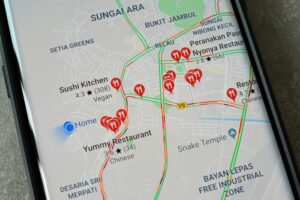
Beyond the three pillars, several specific, actionable elements are critical. Many restaurant owners come to us asking, “why my restaurant ranks lower on Google Maps than competitors,” and if you are currently frustrated by your restaurant not showing on Google Maps for nearby diners, the answer often lies in neglecting these specific details.
- Google Business Profile (GBP) Completeness: A half-finished profile is a major red flag. Ensure every single section is filled out: services offered (e.g., “dine-in,” “takeaway”), accurate hours, menu link, high-quality photos, and a detailed business description.
- Review Quantity and Quality: A steady stream of recent, positive reviews is perhaps the single most powerful prominence signal. It shows Google that your business is active and loved by customers.
- Owner Engagement: Responding to reviews, both positive and negative, signals to Google that you are an active, engaged business owner. This simple act builds trust with both customers and the algorithm.
- On-Page Website Signals: Google also looks at your website. Does your site mention your address? Is your menu available as readable text (not just a PDF)? Does your website load quickly on a mobile phone? These factors help Google confirm the information in your GBP.
How to Improve Local Ranking for Restaurants on Google Maps
Improving your rank is not about finding a secret “hack.” It’s about methodically building trust and providing clear, consistent information.
Start with a thorough audit of your Google Business Profile. Are your categories as specific as possible? Have you uploaded photos of your signature dishes and your interior? Next, create a simple system to encourage happy customers to leave reviews. A small QR code on the bill or a mention from your staff can make a huge difference.
Finally, look at your online presence as a whole. Ensure your restaurant’s name, address, and phone number are identical across all platforms, from Facebook to TripAdvisor. These consistent citations reinforce your prominence and location, directly influencing how Google Maps ranks restaurants.
Securing Your Spot on the Map
The competition for visibility on Google Maps in Singapore is intense, but the rules are not a secret. The process is a marathon, not a sprint, built on consistency and attention to detail. For a busy F&B owner, juggling these digital tasks alongside daily operations can be a significant challenge.
The factors that lead to low visibility are common and, with a focused effort, entirely fixable. Partnering with a team that specializes in the F&B industry can help you systematically address these issues, allowing you to focus on creating an exceptional dining experience while your digital presence works to fill your tables.
If you want to understand exactly what’s holding your restaurant back on Google Maps, you can visit our website to learn more and schedule a free visibility audit with our team.